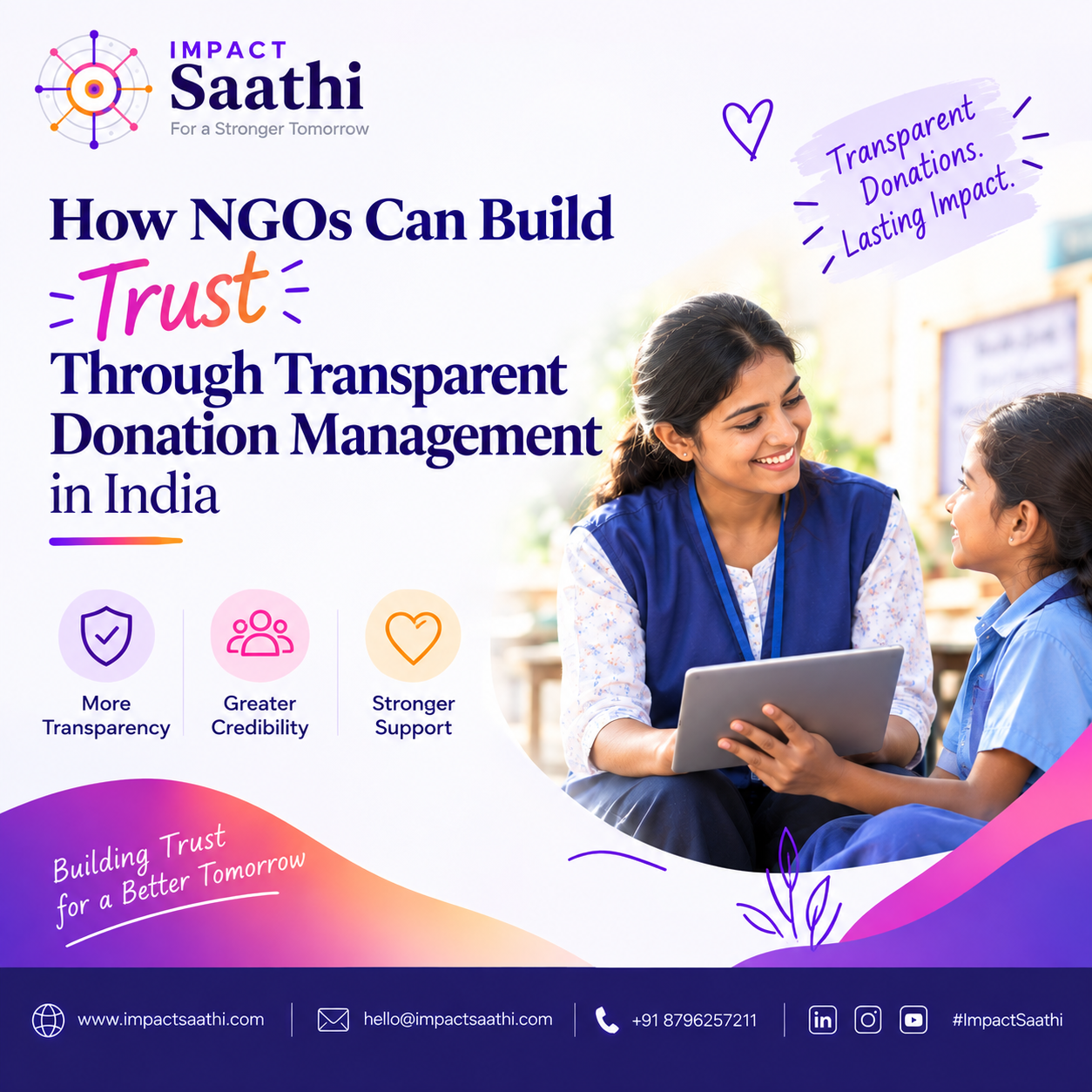
Trust is one of the most valuable assets an NGO can build.
People donate because they believe their contribution can create meaningful change. Whether the donation comes from an individual, a foundation, a corporate CSR team or another institution, donors increasingly want to know what happens after the payment is completed.
Was the donation received correctly?
Was the receipt issued?
Was the money used for the intended purpose?
Can the NGO provide documentation when required?
Can the donor see evidence of the impact created?
These questions make transparent donation management an important part of modern NGO operations.
For many NGOs, however, managing donations is still heavily dependent on spreadsheets, email inboxes, manually prepared receipts and documents stored across different folders. Impact Saathi identifies this exact operational problem and provides a platform focused on the post-donation journey: donation records, automated 80G receipts, fund-utilisation updates and audit trails.
This guide explains how NGOs can build a more transparent donation-management process and why technology can help.
What Is Transparent Donation Management?
Transparent donation management means maintaining a clear and traceable record of the donation lifecycle.
A transparent process should allow an NGO to answer:
Who donated?
How much was donated?
When was the donation received?
Through which payment method?
Was the appropriate receipt generated?
What project or campaign received the funds?
What updates were provided to the donor?
Can supporting records be retrieved during an audit or review?
Transparency is therefore more than publishing an annual report.
It starts with the individual donation.
A strong donation-management system connects the transaction, donor information, receipt, campaign and subsequent utilisation updates into one continuous record.
Why Donor Transparency Matters
1. Transparency strengthens donor confidence
A donor who receives an acknowledgement quickly is more likely to feel that the organisation has a professional process.
The opposite can also happen.
If someone makes a donation and waits several days for a receipt, receives no acknowledgement or never hears how the money was used, uncertainty can develop.
The donation may have been successful, but the relationship has not been successfully managed.
2. Donors increasingly expect evidence
Modern donors are exposed to digital dashboards, online banking, real-time notifications and detailed transaction histories in almost every area of their lives.
They therefore expect similar clarity when supporting social causes.
An NGO does not necessarily need an elaborate technology stack. It does need a reliable process for communicating:
Donation → Receipt → Utilisation → Impact
3. Good records make compliance easier
Transparency and compliance are closely connected.
An NGO that maintains accurate donor records, certificates, receipts and utilisation information is generally in a stronger position when it needs to review its own records or respond to an external requirement.
For organisations approved under Section 80G, donation reporting is also connected with Form 10BD and Form 10BE requirements. The Income Tax Department states that eligible organisations are required to furnish donation information in Form 10BD and issue the corresponding donation certificate in Form 10BE.
The Traditional Donation Management Problem
Many smaller and mid-sized NGOs start with simple tools.
A typical process may look like this:
Donor completes a payment form.
Payment notification reaches the NGO.
Staff member copies the details into Excel.
Receipt is created using a Word template.
Receipt is emailed manually.
Campaign information is maintained separately.
Utilisation information is stored elsewhere.
Donor communication happens through individual email or WhatsApp conversations.
Documents are searched manually when needed.
This process can work when donation volumes are very small.
But as the organisation grows, the number of manual steps increases.
One typo can create an incorrect record.
One missed email can leave a donor without a receipt.
One spreadsheet update can be forgotten.
One certificate can expire without anyone noticing.
The problem is not necessarily a lack of effort.
It is a lack of connected systems.
What Does a Transparent Donation Workflow Look Like?
A better workflow can be designed around five stages.
Stage 1: Capture
The organisation collects relevant donor and transaction information at the time of donation.
This can include:
Donor name
Donation amount
Date
Payment mode
PAN where applicable
Campaign
Consent information
Other required information
Impact Saathi describes its donation flow as capturing donor information and consent with timestamps while maintaining encrypted sensitive data.
Stage 2: Confirm
Once payment is confirmed, the donation should be recorded accurately.
The objective is simple:
The financial transaction should not depend on someone remembering to update a spreadsheet later.
Stage 3: Document
The appropriate donation documentation should be generated and retained.
For 80G-approved organisations, donation reporting has specific requirements. The Income Tax Department's guidance explains that Form 10BD captures particulars of donations and Form 10BE is the certificate issued to donors.
Stage 4: Communicate
The donor should receive confirmation and relevant documentation.
Impact Saathi's platform is designed to automate receipt communication through email and WhatsApp, with the company stating a five-minute receipt turnaround for confirmed donations.
Stage 5: Report utilisation
The relationship should not end when the receipt is sent.
The NGO can provide updates explaining:
What was funded
How many beneficiaries were reached
What activities were completed
What outcomes were achieved
What comes next
This transforms the donation from a transaction into a relationship.
How NGOs Can Improve Donation Transparency
Create a single source of truth
Avoid maintaining separate versions of donor data in spreadsheets, email accounts and individual staff systems.
A centralised record makes it easier to locate:
Donations
Receipts
Campaigns
Certificates
Donor communication
Utilisation updates
Standardise receipts
A receipt should not depend on the person creating it.
Create a standardised workflow that reduces manual data entry and ensures required information is consistently captured.
Introduce certificate alerts
NGOs often maintain multiple registrations and certificates.
An organised certificate vault with expiry reminders can reduce the risk of missing an important renewal or compliance deadline.
Impact Saathi specifically includes certificate storage and expiry alerts for documents such as 80G, 12A and FCRA certificates.
Communicate beyond the receipt
A receipt confirms that a donation was received.
It does not necessarily demonstrate impact.
Consider creating a donor communication calendar:
Donation confirmation
Receipt
Project update
Milestone update
Outcome report
Thank-you communication
Make records audit-ready
A good system should make it possible to retrieve the history of a donation without reconstructing it manually from multiple files.
Where Technology Fits In
Technology should not replace the NGO's mission.
It should remove unnecessary administrative work around that mission.
Impact Saathi positions itself as a compliance layer for Indian NGOs and CSR teams, connecting donation records, 80G receipts, fund-utilisation updates and audit trails.
Its platform includes:
Automated 80G receipts
Campaign management
Donation widgets
Fund-utilisation updates
Donor CRM functionality
Certificate tracking
CSR reporting functionality
The broader idea is important:
Automation should reduce repetitive administration while increasing visibility.
FAQs
What is transparent donation management?
Transparent donation management is the practice of recording, documenting and communicating the complete lifecycle of donations, from receipt of funds to documentation and utilisation updates.
Why is donor transparency important for NGOs?
Transparency helps build donor confidence, supports professional operations and can make it easier for organisations to maintain accurate records and meet applicable compliance requirements.
How can NGOs track donations?
NGOs can use spreadsheets, accounting systems, CRM platforms or specialised donation-management software. The right option depends on donation volume, compliance requirements and operational complexity.
What is an 80G receipt?
An 80G-related donation receipt provides documentation associated with a donation to an organisation approved under Section 80G. Eligible organisations also have reporting obligations relating to donation information and Form 10BE.
How can NGOs improve donor retention?
One effective approach is to communicate after the donation rather than stopping communication at the receipt. Sharing meaningful updates about utilisation and outcomes can help donors understand the difference their contribution made.
Can technology improve NGO transparency?
Yes. A well-designed platform can centralise donation records, automate documentation, track certificates and facilitate donor communication.
Conclusion
Transparent donation management is no longer simply an administrative function.
It is part of the donor experience.
When an NGO can accurately connect a donation to its receipt, campaign, utilisation and impact communication, it creates a clearer and more trustworthy relationship with supporters.
For growing NGOs, the question is not whether transparency matters.
The question is whether the organisation's systems are strong enough to deliver transparency consistently.
That is where dedicated technology such as Impact Saathi can become valuable: by connecting the post-donation process into one auditable workflow instead of leaving each step scattered across spreadsheets, documents and inboxes.