
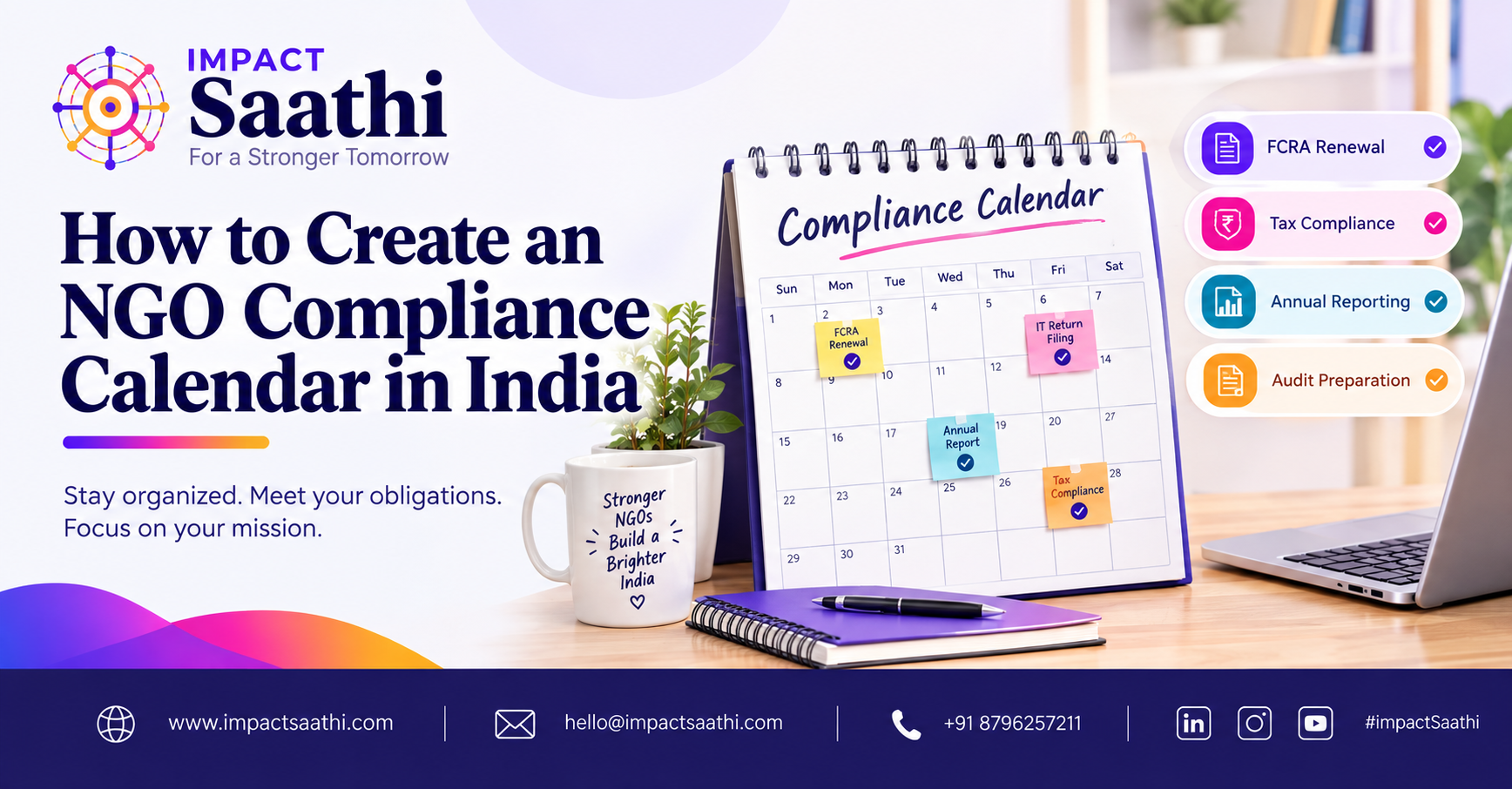
Compliance is one of the most important administrative responsibilities for a nonprofit organisation. NGOs must maintain organisational records, financial documents, registrations, tax-related information, project documentation and other records depending on their legal structure and activities.
The challenge is that compliance is rarely one single annual task.
Different documents can have different validity periods. Different filings can have different deadlines. Different funding arrangements may require different reporting. Some requirements apply to a specific type of organisation or funding arrangement, while others are internal governance requirements.
This is why NGOs can benefit from creating an NGO compliance calendar.
A compliance calendar turns scattered deadlines into a structured management system.
Instead of asking, "When is this document due?", the organisation can see what is due, who is responsible, what documents are required and what action needs to happen next.
What Is an NGO Compliance Calendar?
An NGO compliance calendar is a central schedule containing important legal, regulatory, financial, governance and internal compliance activities relevant to an organisation.
It may include:
Tax-related deadlines
Annual filings
Audit activities
Registration renewals
Certificate expiry dates
FCRA-related requirements where applicable
CSR-related reporting
Grant reporting
Board meetings
Internal reviews
Policy reviews
Financial closing activities
The exact requirements depend on the NGO's legal structure, registrations, funding sources and activities.
Therefore, NGOs should not treat a generic checklist as a substitute for professional legal or tax advice.
Why Every NGO Should Maintain a Compliance Calendar
Without a central calendar, deadlines often exist in different places.
One date may be in an accountant's email.
Another may be in a board meeting note.
Another may be written on a physical file.
Another may be known only to a senior employee.
This creates operational risk.
A compliance calendar creates one shared view.
It can help the NGO answer:
What is due this month?
Who owns the task?
What documents are required?
Has the task started?
Is approval required?
Has the filing been completed?
Where is the supporting document?
When should the activity be reviewed again?
Step 1: Identify Your NGO's Legal Structure
The first step is identifying the legal structure of the organisation.
For example, an NGO may operate as:
A public charitable trust
A society
A Section 8 company
The compliance requirements can differ according to structure.
Therefore, the first version of the calendar should be built specifically for the organisation rather than copied from another NGO.
Step 2: List Your Registrations and Certificates
Create a master list of important organisational documents.
For example:
Document
Issue Date
Expiry/Renewal
Responsible Person
Status
Registration document
Date
As applicable
Admin
Active
12A-related document
Date
As applicable
Finance
Active
80G-related document
Date
As applicable
Finance
Active
FCRA-related document
Date
As applicable
Compliance
Active
CSR-related registration
Date
As applicable
Compliance
Active
The exact documents will vary by NGO.
The important point is that every document should have an owner and a review date.
Step 3: Create a Deadline Register
The next step is to identify recurring deadlines.
A useful register can contain:
Compliance item
What needs to be completed?
Due date
When must it be completed?
Responsible person
Who owns the task?
Reviewer
Who checks the work?
Supporting documents
What evidence needs to be retained?
Status
Not started, in progress, under review, completed or delayed.
This simple structure can significantly improve accountability.
Step 4: Add Financial Compliance Activities
Financial compliance should have its own section.
Depending on the organisation, this may include:
Bookkeeping review
Bank reconciliation
Expense verification
Budget review
Financial statements
Audit preparation
Audit completion
Tax-related activities
Grant reporting
Donor reporting
Monthly financial review is particularly useful because it prevents the organisation from discovering problems only at year-end.
Step 5: Add Document Expiry Alerts
One of the easiest compliance improvements is to track document expiry dates.
Suppose an important certificate expires in December.
The NGO should not discover the expiry in December.
A better system can create reminders:
90 days before
60 days before
30 days before
On the due date
The organisation can then begin the renewal process early.
Impact Saathi specifically includes a certificate vault with expiry alerts for 80G, 12A and FCRA certificates among its platform capabilities.
Step 6: Assign One Owner for Every Compliance Task
A compliance calendar should never contain tasks without owners.
Instead of:
"Annual filing — December"
write:
"Annual filing — Finance Manager — Review by 15 November — Final completion by applicable deadline."
Ownership creates accountability.
If a person leaves the organisation, the task can be reassigned without losing institutional knowledge.
Step 7: Introduce Monthly Compliance Reviews
Do not wait until deadlines are approaching.
A monthly compliance meeting can review:
Completed
Which tasks were finished?
Upcoming
What is due during the next 30–60 days?
Delayed
Which tasks are behind schedule?
Documents
Are supporting documents available?
Risks
Are there any issues requiring professional advice?
A 30-minute monthly meeting can be sufficient for many small organisations.
Step 8: Maintain an Audit-Ready Folder
Every completed compliance activity should have supporting evidence.
A digital folder could contain:
Compliance
→ Registration
→ Tax
→ FCRA
→ CSR
→ Audit
→ Annual Reports
→ Board & Governance
Each completed activity should have:
Filing acknowledgement
Final document
Payment receipt where relevant
Supporting documentation
Approval records
Correspondence where relevant
This makes future audits much easier.
Step 9: Use a Status System
A simple status structure can help management.
Green: Completed and documented.
Yellow: In progress or approaching deadline.
Red: Overdue or requires immediate attention.
The colours are not the important part. Consistency is.
Step 10: Connect Compliance With Responsibilities
Compliance should not exist separately from daily operations.
For example:
The fundraising team should know which donor information needs to be captured.
The finance team should know which supporting documents must be retained.
The programme team should know what project reports are required.
The administration team should know when certificates need renewal.
This turns compliance from a finance-only responsibility into an organisational process.
Example Monthly Compliance Calendar
January
Review previous year's records
Check certificate validity
Review donor database
Reconcile financial records
Confirm upcoming reporting deadlines
February
Internal documentation review
Grant reporting preparation
Review programme records
March
Financial year-end preparation
Budget review
Supporting document reconciliation
April
New financial year planning
Compliance calendar update
Budget approval
Project documentation review
The exact activities will vary by NGO.
Common Compliance Calendar Mistakes
Mistake 1: Keeping the calendar with one person
If only one employee knows the deadlines, the organisation becomes dependent on that employee.
Mistake 2: Tracking only legal deadlines
Internal reporting and grant deadlines matter too.
Mistake 3: Not storing evidence
Completing a task is not enough. Supporting documentation should also be retained appropriately.
Mistake 4: No advance reminders
A deadline reminder on the due date may be too late.
Mistake 5: Using an outdated checklist
Compliance requirements can change. NGOs should periodically verify their obligations with qualified professionals and official sources.
How Technology Can Help
Digital systems can automate several parts of compliance management.
For example:
Central document storage
Expiry reminders
User permissions
Activity history
Reporting dashboards
Digital approvals
Searchable records
The objective is not to automate legal judgment. It is to automate administration around the process.
Conclusion
An NGO compliance calendar is one of the simplest systems an organisation can create to improve administrative discipline.
It provides visibility, ownership and advance warning.
The most effective calendar is not necessarily the most complicated. It is the one that is accurate, regularly reviewed and connected to the organisation's actual responsibilities.
NGOs should start with their legal structure, registrations, financial obligations, reporting requirements and internal deadlines.
From there, every task should have a due date, owner, reviewer and supporting documentation.
With a structured calendar, compliance becomes a continuous management process rather than a last-minute emergency.
FAQs
What is an NGO compliance calendar?
It is a central schedule used to track important legal, financial, regulatory, reporting and internal compliance activities.
Does every NGO have the same compliance requirements?
No. Requirements can vary depending on the NGO's legal structure, registrations, funding sources and activities.
How often should an NGO update its compliance calendar?
It should be reviewed regularly, preferably monthly, and updated whenever there is a change in requirements, registration status or organisational activities.
Who should manage an NGO compliance calendar?
It can be managed by an administration, finance or compliance professional, but important tasks should have clearly assigned owners.
Should certificate expiry dates be included?
Yes. Tracking important certificates and renewal dates helps organisations begin renewal processes before documents expire.
Can a spreadsheet be used as a compliance calendar?
Yes. A spreadsheet can be a useful starting point. Larger NGOs may eventually require dedicated compliance-management functionality.
Should NGOs seek professional compliance advice?
Yes, especially where tax, regulatory or legal interpretation is involved. A calendar helps organise the work but does not replace professional advice.