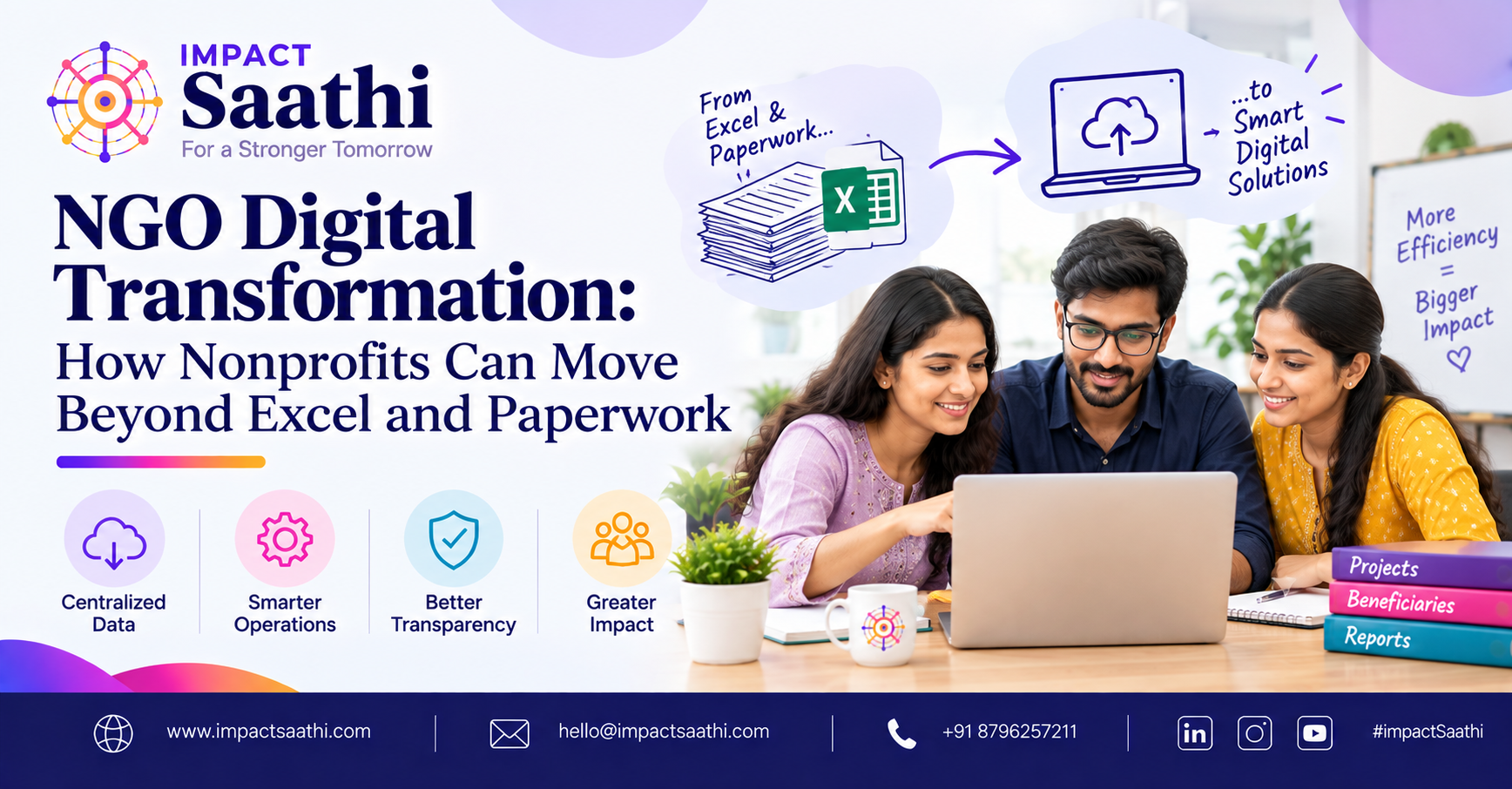
Non-governmental organisations play an important role in addressing social, economic, educational, environmental and community challenges across India. But while NGO programmes are becoming more sophisticated, many organisations still depend heavily on spreadsheets, paper files, email chains and manually maintained documents for their day-to-day administration.
Excel is useful. Paper records are sometimes necessary. Email remains essential. The problem begins when these tools become the primary system for managing donors, finances, compliance documents, volunteers, projects and reporting.
As an NGO grows, information becomes distributed across different people and locations. One employee may maintain donor data, another may manage receipts, another may keep certificates, while the finance team maintains financial spreadsheets. This can create duplication, delays, inconsistent records and unnecessary administrative work.
This is where NGO digital transformation becomes important.
Digital transformation does not simply mean purchasing software. It means redesigning organisational processes so that information can be captured, managed, shared and reported more efficiently.
For NGOs, the objective should be straightforward: spend less time managing administrative complexity and more time delivering social impact.
What Is NGO Digital Transformation?
NGO digital transformation is the process of using digital technologies to improve an organisation's operations, communication, fundraising, compliance, financial management and programme delivery.
It can include:
Digital donor management
Online fundraising
Automated donation receipts
Digital financial records
Cloud-based document management
Compliance reminders
Volunteer management
Programme monitoring
Digital reporting
Data dashboards
Automated communication
Secure information storage
Digital transformation does not mean that every NGO needs expensive enterprise software.
A small NGO may begin with a structured cloud document system and a central donor database. A growing organisation may introduce a dedicated NGO management platform. A larger NGO may integrate fundraising, finance, programme monitoring and reporting systems.
The right approach depends on organisational size, budget, team capability and operational complexity.
Why NGOs Need to Move Beyond Spreadsheets
Spreadsheets are flexible, inexpensive and familiar. However, they become difficult to manage when multiple people need access to the same information.
Imagine an NGO receives 2,000 donations during a year.
The organisation may need to track:
Donor name
Contact information
Donation amount
Donation date
Payment method
Receipt number
80G information
Campaign
Fund utilisation
Donor communication
Follow-up activity
If this information is maintained across several spreadsheets, errors become increasingly difficult to identify.
One spreadsheet may contain 1,950 donors while another contains 2,000. A receipt may have been generated but not recorded. A donor may have changed their email address without the change being reflected everywhere.
A centralised digital system can reduce these problems by creating a single source of operational information.
1. Start With Process Mapping
Before purchasing technology, an NGO should understand how its current processes work.
Create a simple map for important activities.
For example:
Donation process
Donor visits website → donation submitted → payment confirmed → receipt generated → donor notified → fund utilisation update → reporting.
Compliance process
Certificate received → document stored → expiry date recorded → reminder generated → renewal initiated → updated certificate stored.
Volunteer process
Volunteer registers → skills recorded → opportunity identified → volunteer assigned → hours recorded → participation reported.
Process mapping helps identify where manual work is creating unnecessary delays.
2. Create a Centralised Data Structure
One of the biggest advantages of digital transformation is the ability to create a central source of information.
An NGO should identify its core data categories.
Donor data
Maintain structured information about:
Individual donors
Corporate donors
Donation history
Communication preferences
Consent
Campaign participation
Financial data
Track:
Income
Expenses
Project allocations
Fund utilisation
Supporting documents
Payment records
Compliance data
Maintain:
Registration documents
12A-related documentation
80G documentation
FCRA documentation where applicable
Tax records
Audit documents
Renewal dates
Programme data
Track:
Projects
Beneficiaries
Locations
Activities
Outputs
Outcomes
Budgets
Progress
The objective is not simply to store more data. It is to make the right information easier to find and use.
3. Digitise Important Documents
Paper documents can be difficult to search, share and protect.
NGOs should consider creating a structured digital document repository.
A useful folder structure might include:
01 Organisation Documents
02 Registrations
03 Tax & Compliance
04 Finance
05 Donors
06 Projects
07 CSR Partners
08 Audits
09 HR & Volunteers
10 Policies
Each document should have a clear naming convention.
Instead of:
certificate-final-new.pdf
use:
80G_Certificate_OrganisationName_2026.pdf
Clear naming conventions make retrieval much easier.
4. Introduce Automated Reminders
Many NGO administrative problems occur because important activities depend on human memory.
Examples include:
Certificate expiry
Reporting deadlines
Audit preparation
Donor follow-ups
Grant reporting
Project milestones
Contract renewals
Volunteer schedules
Automation can reduce the risk of forgetting these activities.
A digital system can send reminders before important dates, allowing staff to act proactively rather than reactively.
5. Digitise Donor Management
Donor relationships are long-term assets for NGOs.
A donor database should provide a structured view of the relationship.
Instead of simply storing a donor's name and phone number, NGOs can track:
First donation
Most recent donation
Total contribution
Campaigns supported
Communication preferences
Receipt history
Updates received
This helps an NGO understand its donor base and communicate more appropriately.
A consent-first approach is also important when handling personal information.
Impact Saathi, for example, describes its donor CRM as DPDP-compliant and consent-first, reflecting the increasing importance of privacy-conscious donor management in India's nonprofit sector.
6. Improve Financial Visibility
Digital transformation should also improve financial visibility.
NGO management should be able to answer questions such as:
How much was raised?
Which campaign generated the funds?
How much has been utilised?
Which project received the funds?
What expenses have been recorded?
What remains available?
This does not necessarily mean creating complex dashboards.
Even a simple digital reporting structure can significantly improve management visibility.
7. Build a Digital Compliance System
Compliance should not be treated as an annual activity.
An NGO should maintain a compliance calendar covering relevant requirements and internal deadlines.
The system should identify:
Requirement
Responsible person
Due date
Status
Supporting document
Renewal date
Review date
Digital compliance systems can also provide alerts when important documents approach expiry.
This reduces dependence on individual employees remembering critical dates.
8. Improve Volunteer Management
Volunteers can become difficult to manage as programmes expand.
A digital volunteer system can record:
Volunteer details
Skills
Availability
Assignments
Attendance
Hours contributed
Training
Participation history
This allows NGOs to understand not just how many volunteers they have, but how much capacity those volunteers provide.
Impact Saathi currently lists volunteer registration, skills tracking, assignment and hour logging among its platform capabilities.
9. Train Employees Before Introducing Technology
Technology fails when employees do not understand how to use it.
Before launching a new system, NGOs should:
Identify users.
Define responsibilities.
Provide training.
Create standard operating procedures.
Start with a pilot.
Collect feedback.
Improve the process.
The goal should be adoption, not simply implementation.
10. Protect NGO Data
Digital transformation creates new responsibilities around data security.
NGOs may handle:
Donor information
PAN-related information
Contact details
Beneficiary information
Employee information
Financial records
Access should therefore be based on roles.
For example:
A volunteer may need access to volunteer information but not financial records.
A finance employee may need access to financial information but not every donor communication record.
Administrators should periodically review user permissions and remove access when people leave the organisation.
11. Measure the Impact of Digital Transformation
An NGO should measure whether digital transformation is actually helping.
Useful indicators include:
Time required to issue receipts
Time spent preparing reports
Number of manual data-entry tasks
Document retrieval time
Compliance deadlines missed
Donor response rate
Data duplication
Administrative cost
Staff adoption rate
If administrative work falls while data quality and reporting improve, the transformation is producing measurable operational value.
Conclusion
NGO digital transformation is not about replacing people with technology. It is about giving people better systems.
Spreadsheets, paper files and email can remain useful tools, but they should not become barriers to growth.
A practical transformation journey starts with process mapping, centralised data, digital documents, automated reminders, better donor management, financial visibility and stronger compliance processes.
For NGOs, the ultimate objective is simple: less administrative friction and more time for mission delivery.
The organisations that approach digital transformation gradually, securely and strategically can create stronger foundations for long-term growth.
FAQs
What is digital transformation for NGOs?
It is the use of digital tools and redesigned processes to improve NGO operations, fundraising, compliance, financial management, reporting, communication and programme delivery.
Does a small NGO need digital transformation?
Yes, but the approach can be simple. A small NGO can start with cloud document management, structured spreadsheets, digital communication and basic donor management before adopting more advanced platforms.
Is Excel still useful for NGOs?
Yes. Excel remains useful for analysis, budgeting and temporary data work. The challenge is relying on spreadsheets as the only system for complex organisational information.
How can NGOs start digital transformation?
Start by identifying repetitive manual processes, mapping workflows and selecting one area for improvement. Donor management, document management or compliance tracking are common starting points.
Is NGO data security important?
Yes. NGOs may handle sensitive donor, beneficiary, employee and financial information. Access controls, secure storage, backups and appropriate privacy practices should be part of the digital strategy.
How long does NGO digital transformation take?
There is no fixed timeline. It depends on organisational size, technology maturity, data quality, staff capability and the number of processes being changed.
What is the biggest mistake NGOs make during digital transformation?
Buying technology without first understanding the underlying process. Technology works best when the organisation clearly defines what needs to improve before selecting a tool.